Since 2008, European-American University has contracted with independently owned and run campus centres, designated International Partners, which have prepared students for taught, campus-based programmes (usually leading to their own diploma or certificate award) that have subsequently been validated with the University’s degrees. The majority of these International Partners have been located in sub-Saharan Africa with many in Nigeria.
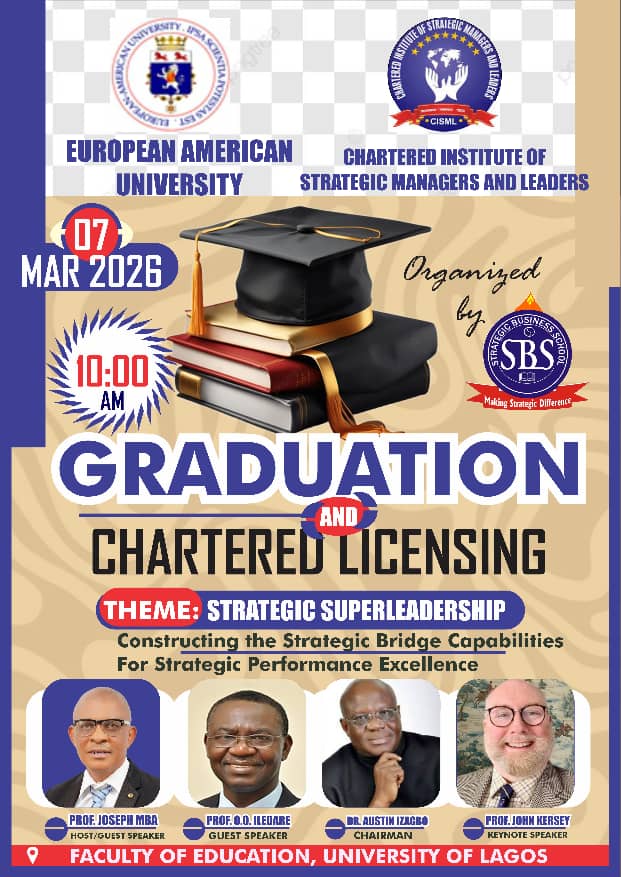
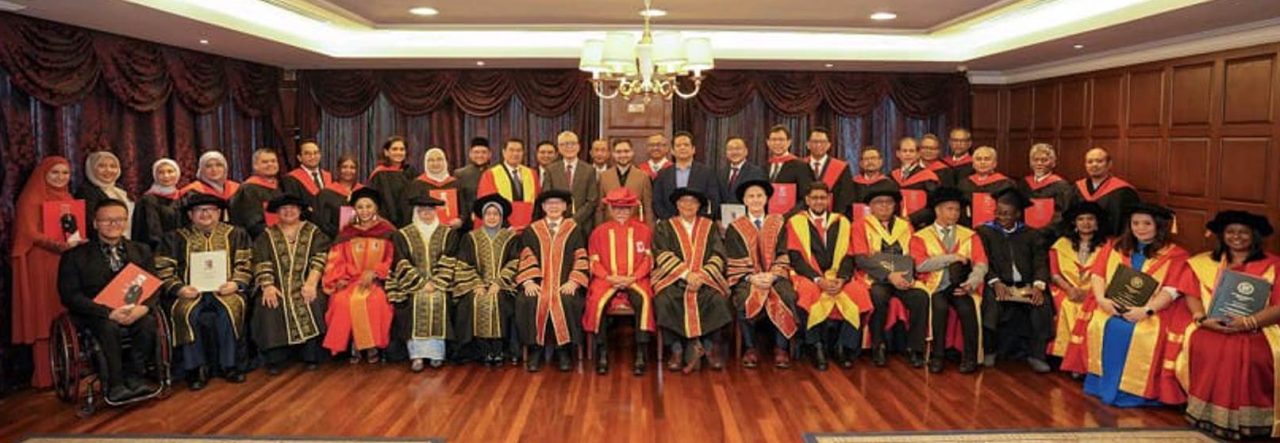
Alongside this, the University has run a highly successful system of awarding honorary degrees to men and women of achievement in sub-Saharan Africa through convocation ceremonies, many of which have taken place in Nigeria (the photograph above shows a ceremony from 2023). This has attracted a great deal of positive press attention as well as generating support for the University and its operations.
The University was recently made aware via press reports of two incidents in June and September 2025 when several people in Nigeria, including a prominent musician, received fake honorary degrees that were issued fraudulently in the name of the University and without its knowledge or consent. The legal authority cited for these awards was expired past authorities of the University in Dominica and Panama that had ended in 2019 and 2023 respectively and had never overlapped, making these documents legally invalid as well as unauthorized.
These incidents occurred with the involvement of a former officer of the University who had been dismissed from her position in April 2025. The University’s position was made the subject of a public statement, and this was reported accurately by major media outlets including the BBC and several Nigerian newspapers.
Media coverage:
Daily Post (Nigeria): https://dailypost.ng/2025/09/21/its-fake-european-american-university-disowns-musician-rararas-degree
The Guardian (Nigeria): https://guardian.ng/features/education/european-american-varsity-alerts-nigeria-over-fake-abuja-convocation
BBC Pidgin: https://www.bbc.com/pidgin/articles/cj9zz7m8p7go
The University reported these incidents to law enforcement in Nigeria for its action, and took the step of temporarily suspending all International Partners in that country until the matter could be resolved. The University issued an offer to those who received fraudulent honorary degrees in the mistaken belief that they were genuine to contact the University so that it could remedy their situation, since it regarded them as most likely having been innocent victims of the fraudsters. However, this offer was not taken up.
Although most major media outlets both in Nigeria and internationally have covered this story responsibly and accurately, and the University is grateful to its alumni who have contacted the press to help bring about a solution to the problems, there has also regrettably been some inaccurate and defamatory coverage of the University in minor Nigerian media outlets, and the University notes that contrary to basic standards of journalistic integrity, not a single journalist of these publications has made contact with the University to check the facts of the case with us before rushing into print, nor did they report the statement that the University had issued in order to correct this misinformation.
The overwhelming majority of the University’s contacts with Nigeria over well more than a decade have been positive and productive, with good relations with both the Christian and Muslim communities there. During the majority of the International Partner Programme’s time the University has worked effectively with its International Partners in Nigeria, and has taken great pride in the success of its graduates and the recipients of honorary degrees. However, it is clear that in this present situation, the University has also had to deal with the opposition of a corrupt and unaccountable section of the Nigerian media which does not conform to basic guidelines of fair reporting or right to reply.
While the University is committed to continuing its relationship with those International Partners which are still active and productive, and is now lifting its temporary suspension in favour of these institutions, it is with an awareness that increasing corruption and fraud in Nigeria make it extremely difficult for foreign organizations such as the University to continue to be involved in that country. It has been widely circulated that university accreditation in Nigeria is now obtained by bribery, with those who do not pay bribes being disclaimed.
Similarly, at least some of the negative press coverage the University has recently experienced in Nigeria is the result of bias towards domestic university interests that are opposed to the University as a nontraditional private provider of higher education. Another likely reason for such media coverage is that those who have been exposed as trying to defraud the University have sought to take revenge against it.
The University also notes that the Nigerian government authorities have become increasingly hostile to foreign universities in recent years. The University remains committed to maintaining the highest academic standards, and to ensuring that any activity is in strict compliance with the law of the country concerned. It has never engaged in the paying of bribes since this would be both illegal and against the principles which govern its mission.
The public is advised that all graduates of the University with both earned and honorary degrees are listed on its Register of Graduates, which serves to protect the University and its graduates against false claims. Any person who is not listed there is not a graduate of the University.
All International Partner campuses are listed on the University’s website and are required to comply with all laws and regulations that may apply in their countries. Verification of any International Partner may be made by contacting the University. The University has also removed any International Partners in Nigeria that are no longer pursuing an active ongoing relationship with the University. The High-Grade Education Centre in Lagos has ceased to be an International Partner of the University since April 2025, and the University has also discontinued its former position of Head of All-Africa Operations.
The University’s honorary degree programmes in respect of African honorands are now co-ordinated in Togo by Professor Klousse Komlan John (Pro-Vice-Chancellor) and in Nigeria by Professor Luke Okojie (Pro-Vice-Chancellor). Bedopps International Services in Nigeria is also authorized to recommend persons for honorary degree conferral. The University will announce and feature all future honorary degree ceremonies on its website.
You must be logged in to post a comment.