
Degrees available
European-American University awards degrees at bachelor, master and doctoral levels in the areas of business, education, music, religion, the arts and humanities in general, and a limited number of scientific areas including information technology. It does not award degrees in medical or paramedical disciplines, or degrees in the licensed professions except for those who are already professionally qualified and licensed. It can also accommodate bespoke, self-designed degree programmes that may include interdisciplinary work or more unusual subjects, provided it can offer the necessary tutorial and examining support.

European-American University’s degrees generally follow the American pattern of education although there are also some European elements.
For information about the legal powers under which the University awards degrees (referred to by the term “accreditation” in some countries), please see the Status page below.
>>Status
The provision for the award of degrees by private higher education providers in France include restrictions on several degree titles. European-American University’s degrees are not in any way related to the French national curriculum or to the degree titles that are part of it. Like other French private providers of higher education hors contrat, the University’s degrees are awarded in English and refer to levels in the American education system rather than that of France. The title of master of (business administration, arts, science etc.) conferred by the University in the context of an American-style degree is not to be confused with and is in no way the same as the French grade de master. European-American University also uses its separate degree-awarding powers under its Royal Charter from Bunyoro-Kitara as a supplementary authority for all degree awards, which authority allows it to award degree titles that would not be able to be awarded in France.
Degree levels available
- Doctoral degree programmes
- Master’s degree programmes
- Bachelor’s degree programmes
- Certificate in Relational/Existential Approach to Autism
- Certificate in Addiction Recovery Studies
Classroom study and distance learning
Students who wish to complete an EAU degree by campus study in a traditional classroom setting can do so at a network of some twenty affiliated partner campus institutions, mostly located in Africa.
Other students will prepare for their programme through one-to-one distance or correspondence study with a mentor. Most of these students use email to communicate with their mentor and the University, although traditional postal mail is also acceptable. The University does not offer online courses. All programmes are capable of a high degree of individual customization, subject to University approval. There are no classes or cohorts of students in the distance learning programme. It is possible to enrol at any time of the year, and a student may complete at their own pace, subject only to an annual continuation fee payable on the anniversary of matriculation.
It is possible for some students to pursue a blended learning programme with elements of both classroom and distance learning.
Graduation occurs when the University confirms to the student that all academic and financial requirements of their programme have been met. The student may opt to attend a convocation ceremony to graduate in person, or, if they are unable to attend the ceremony, their graduation documents will be sent to them by mail.
The University has also from its inception accepted students who are currently in prison, considering education to be a vital element in the rehabilitation of offenders. In order to enrol, students who are incarcerated will need the permission of the prison authorities, who will generally have their education department communicate with the University directly in order to plan and implement the programme of study and assessment.
Top-up programmes
The option of a top-up programme is particularly popular at the bachelor’s degree level. Often a candidate will have completed a previous university-level diploma or other professional credential that fulfils a significant proportion of the requirements for a bachelor’s degree. In this situation, they need only complete a top-up dissertation or professional project in order to progress to the bachelor’s degree. Holders of diplomas in music are often suitable candidates for these programmes.
Programme structure
With the exception of those classroom programmes that feature a cohort of students following a common curriculum, the majority of the programmes offered by the University are individually designed. Although model frameworks are available in some areas for guidance, most of our students relish the opportunity for individual input in their studies and have clear ideas of what they want to achieve and how they intend to get there.
At an initial stage, typically before formal admission, the candidate is asked to set out a framework of intended study that can form the basis of a learning contract. They may do this on the basis of existing interests within a subject, look to skills and strengths that they feel they wish to demonstrate at degree level, or explore hitherto unfamiliar areas where they wish to gain a more in-depth appreciation. They may wish to study with a particular faculty member of the University in order to take advantage of their expertise in a particular field at high level. The learning contract is reviewed by the University at this early stage to ensure that supervision and examination can be provided to support the desired programme adequately, as well as to assess that the proposal will meet the expected academic standard for the degree concerned.
There is no requirement for formal examinations as part of most programmes. Assessment is typically via coursework, with an essay or paper set to test understanding of each topic or part thereof, and feedback offered by a mentor who reports on the student’s achievement to the University. More experienced candidates may wish to complete one or more major pieces of work for degree assessment. At the doctoral level, this will often consist of research with an original component, leading to scholarly output that would be of publishable quality.
Assessment of prior learning and previously published work
European-American University has particular expertise in the accreditation of prior learning (VAE, APL, APEL) gained through learning experiences that may have occurred within or outside the classroom. The VAE (validation des acquis de l’expérience) is an accelerated experiential assessment process based on a landmark French law of 2002 that for the first time brought experiential assessment into the mainstream of college education. It has since been implemented by both public and private institutions both within and beyond France. At European-American University, VAE is offered by distance assessment to an international, primarily English-speaking student body.
Many adults have gained previous non-degree credentials, together with significant learning experiences in the course of their professional history. The University can assess all of these sources of learning and apply them to meet the requirements of a degree programme.
- Further information about APL/APEL assessment
- How to earn a degree through the University’s VAE process
If you have published books or articles in professional journals, you may be eligible to pursue a degree through the assessment of previously published work. This option is usually undertaken at the doctoral level, where it provides a route to the Ph.D. degree. For those who have substantial publications above this level, it is possible to be a candidate for a higher doctorate (Doctor of Letters, Doctor of Science).
Honorary awards
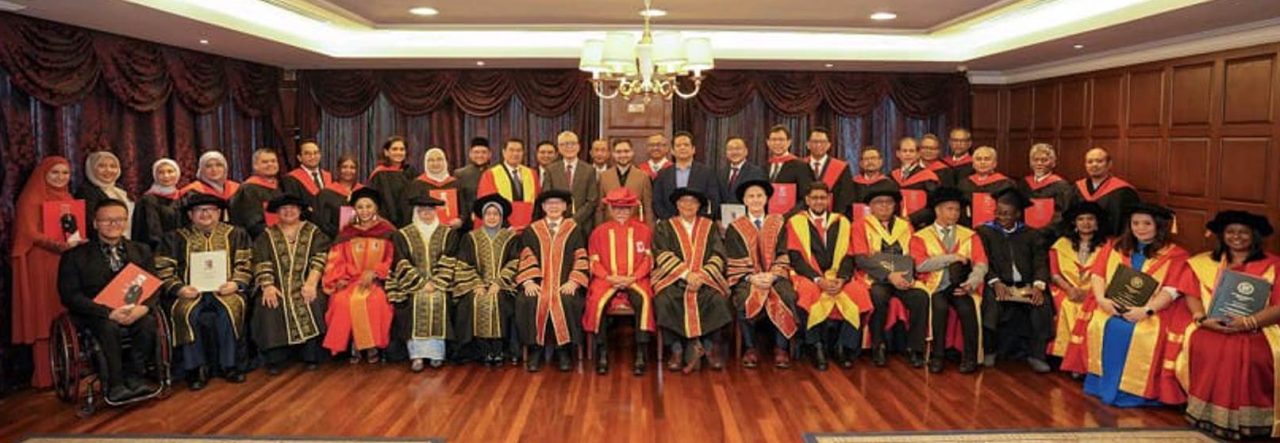
The University makes a number of honorary awards, usually at the doctoral level, each year to persons who have distinguished themselves in any field, to those who have rendered support to the University, and to those who have given distinguished service to the University. Over the years, the University has become known as a leading source for the recognition of leadership and achievement of African leaders in particular, and for that reason the proportion of honorary degrees awarded is larger than at many other universities.
Candidates for honorary degrees must be nominated by an authorized representative of the University, and self-nomination or the nomination of individuals by third parties without connection to the University is not permitted.
Honorary degrees may be rescinded after their conferral under certain circumstances where the holder is deemed to have acted in such a way as to bring the University into disrepute. Criminal conviction where the integrity or honesty of the person concerned is at issue is one such circumstance, and the other main circumstance is professional disbarment (whether temporary or permanent) by a regulatory authority. In such circumstances the University will remove the award from its Register of Graduates and note the reason for doing so there.
Degrees ad eundem
The University also extends to some faculty members and others associated with the University the privilege of incorporating a degree earned elsewhere so that they may also be awarded the same degree of the University, a process that can also be undertaken through VAE assessment.
Further religious degree opportunities at The Western Orthodox University
 European-American University has the power to award religious degrees under its own authority from France, however, it is also affiliated to The Western Orthodox University, Hawaii, USA, which was established in 1945 and is a religious university of the Apostolic Episcopal Church. Information about The Western Orthodox University and its programmes can be found at its website.
You must be logged in to post a comment.